About
This is an unofficial fan website devoted to the history of the Lords of Kinfauns. Few titles have a story to match it. It starts with a pardoned pirate on the Tay, passes through some of the great houses of Scotland, and is held today at Newhall House, beside the ruins of Killone Abbey in County Clare. The site is simply a record put together out of enthusiasm for that story. It is not written or approved by Lord Kinfauns, and the family’s official website is kinfauns.co.
Links
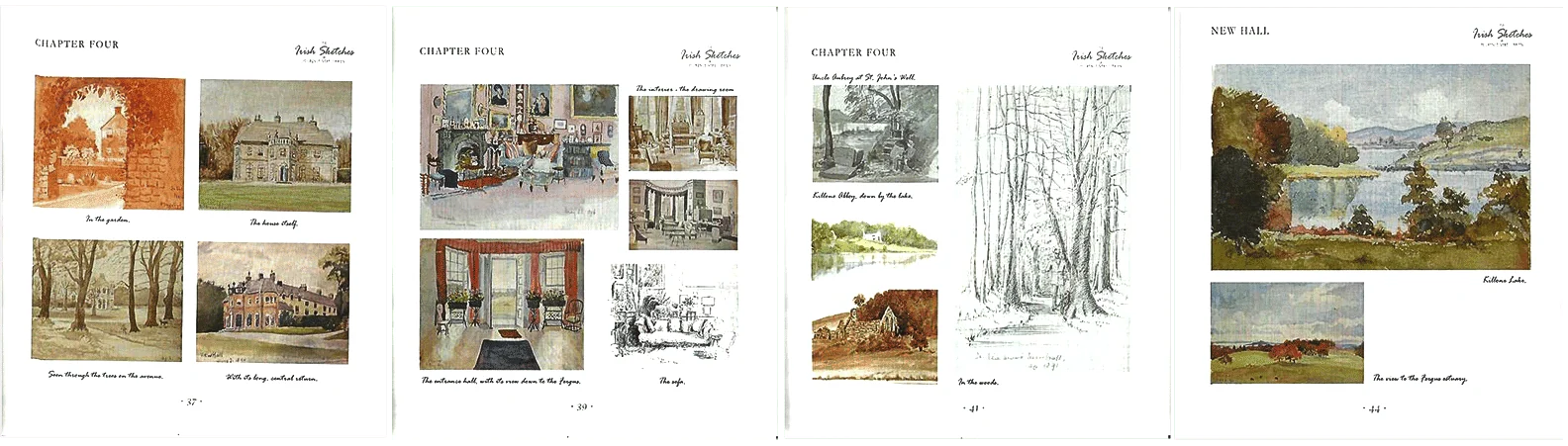
If you would like to learn more about Newhall, seat of the Lords of Kinfauns, several excellent books exist — including those of Florence Vere O'Brien, who lived at Newhall in the 1890s.
History
Lordship of Kinfauns
The paper trail starts in 1487, when the lordship was confirmed under King James III, and it was confirmed again in 1608 under King James VI, who was also King of Ireland. Both were confirmations of an older creation. The earliest charter known, by which King David II granted half of the lands of Kinfauns in 1330, survives in a private collection. Legend adds the best part, and credits that first grant to a onetime sea pirate, Sir Thomas Charteris, who was pardoned and knighted. His story is told at length elsewhere on this site. The line of succession later merged into the Earldom of Moray, one of the seven ancient earldoms of Scotland, and stayed there for generations before devolving upon the Commane family under the succession provisions of the original charter.
Better still, the lordship comes with a hereditary office of its own, the Admiralty of the Tay, granted by the Crown upon the heirs and successors of the lordship of Kinfauns and a reminder of how the barony once commanded the river in Perthshire. Tradition says ships passing Kinfauns Castle dipped their flags to it.
A Legacy Restored
Newhall House & Killone Abbey
Just outside Ennis in County Clare stands Newhall House, an estate with a documented pedigree reaching back to the Tudor period. Its recorded history opens in 1544, when Henry VIII made over Killone Abbey and the lands around it, Newhall among them, to Murrough O'Brien, 1st Earl of Thomond, under the Crown's surrender-and-regrant arrangement. The house itself, with its stable block, began to take shape around 1650 under the Viscount Clare, and at its largest is said to have covered some 9,000 acres, functioning as a hub of local social and economic life.
A short distance from the house stand the ruins of Killone Abbey, an Augustinian foundation traditionally dated to 1190 under Donal Mór O'Brien, King of Munster, long regarded as a refuge for women of noble birth within Gaelic Ireland's monastic life. Suppressed along with the other religious houses, it survives today only in fragmentary Gothic stonework, while close by, the Holy Well of St John the Baptist — associated with pre-Christian offerings — still draws those who come to see it.
The modern chapter reads like a novel. Fergus Commane was one of eleven children raised on his parents’ farm, which looked straight across at the great house of Newhall and stood on ground once counted as part of the estate. Like so many of his Irish contemporaries he left for London, and he made a success of business while still young. He never let go of the idea of taking on Newhall and putting it right.
Under the Commanes the house is lived in by a family again, and a wellness retreat is planned for the grounds, shaped around the site’s folklore and spiritual associations. Fergus is custodian of the Holy Well of St John and Killone Abbey, which is welcome news for anyone who cares about either.
Gaelic nobility of Ireland
As if a Scottish lordship were not enough, the family has a Gaelic pedigree to go with it. Genealogical sources and DNA analysis link the Commanes in the direct male line to the Déisi Muman, the early medieval kings of the Déisi of Munster, and to the historic Chiefdom of Tulach Commáin, "the fort of The Commane", their chief.
By tradition, the family line is traced to a 3rd-century figure called Ferchess mac Commán (anglicised as Fergus Commane), described in the Irish annals as a fían fighter, a seer, a poet, and a lord of the Gaelic order, attached to the household of King Ailill, who governed the south of the country. Early Irish sagas tell how Ailill charged Ferchess with avenging the killing of his son Éogan by striking down Mac Con, then High King of Ireland.
The family's patron is Saint Commán, who founded monasteries at Roscommon and Kinvara in the 6th century.